
DOAJ is a community-curated online directory that indexes and provides access to high-quality, open access, peer-reviewed journals. DOAJ is independent. All funding comes from donations, 50% from sponsors and 50% from members and publishers. All DOAJ services, including being indexed in DOAJ, are free of charge. All data is freely available. DOAJ runs a worldwide education and outreach program focused on improving the quality of the applications submitted.
To access the database, click here.
It contains 1,415,102 open access electronic publications in the fields of physics, mathematics, computer science, quantitative biology, quantitative finance, statistics, electrical engineering and systems science, and economics.
arXiv is a free open access service in these fields, and submitted works are expected to meet Cornell University's academic standards. It is operated by Cornell University, a private not-for-profit educational institution, and funded by Cornell University Library, the Simons Foundation and member institutions.
To access the database, click here.
BASE is one of the most comprehensive search engines for academic web resources. It provides more than 150 million documents from more than 7,000 sources. The full texts of approximately 60% of the indexed documents can be accessed free of charge through open access. It is operated by Bielefeld University Library.
BASE is one of the world's most voluminous search engines especially for academic web resources. BASE provides more than 150 million documents from more than 7,000 sources. You can access the full texts of about 60% of the indexed documents for free (Open Access). BASE is operated by Bielefeld University Library.
To access the database, click here
.
Scope: Social sciences, linguistics, psychology, law, geography, physical education, history, economics, literature, art studies, women's studies, management, philosophy and logic, library science, political science, humanities and Islamic sciences.
To access the database, click here.
Founded in 1683, Brill is a publishing house with a long history and a strong international network. Its publications focus mainly on the humanities, social sciences, international law and selected areas of science. Brill's principal subject areas are as follows:
- African Studies
- American Studies
- Ancient Near East and Egypt
- Art and Architecture
- Asian Studies
- Biblical Studies
- Biology
- Classical Studies
- History
- Human Rights and Humanitarian Law
- International Law
- International Relations
- Jewish Studies
- Language and Linguistics
- Middle East and Islamic Studies
- Philosophy
- Religious Studies
- Science
- Slavic and Eurasian Studies
- Social Sciences
To access the database, click here.
Crossref is a not-for-profit organization that makes research outputs easier to find, cite, link and assess. It holds only metadata and directs users to the source itself via the relevant identifier (ID). It is the registration agency for the Digital Object Identifier (DOI).
It lists all publications that have been assigned a DOI, whether paid or free, and directs users to the relevant web page. It is an unrivaled treasury of data for researchers.
What it includes:
- Books
- Journals
- Conference papers
- Standards
- Technical reports
- Working outputs
- Theses
- Components (figures, tables)
- Datasets (supplementary data)
- Preprints
- Peer review
To access the database, click here.

You can access theses and dissertations produced in Europe.
DART-Europe is a partnership of research libraries and library consortia working together to improve global access to European research theses. It is endorsed by LIBER (Ligue des Bibliothèques Européennes de Recherche) and is the European Working Group of the Networked Digital Library of Theses and Dissertations (NDLTD).
DART-Europe partners provide access to electronic theses and dissertations (ETDs) through a single European portal and contribute to the development of the European e-thesis infrastructure.
To access the database, click here.
Under the umbrella of TÜBİTAK ULAKBİM, it provides electronic hosting and editorial process management services for academic journals published in Türkiye.
Purpose
- To ensure that academic periodical publishing in Türkiye develops in a high-quality manner and in line with standards,
- To increase the worldwide visibility and use of national academic journals,
- To ensure the widespread and advanced use of the system that enables journals to be managed electronically,
- To provide measurable and clean data for TR Dizin and the National Citation Index.
To access the database, click here.
1.5 billion links connected to 140 million documents; profile information and activities of 20 million researchers; tracking of research grants; publications, citations, clinical trials, patents and policy documents.
We recommend that you use filters.
To access the database, click here.
The Digital Commons Network provides free access to full-text scholarly articles and other research outputs from hundreds of universities and colleges worldwide. Curated by university librarians and the institutions that support them, this tool includes peer-reviewed journal articles, book chapters, theses, working papers, conference proceedings and other original scholarly work.
By clicking "Explore" on the multicolored Disciplines Wheel you can open the Commons page for the relevant academic discipline; you can browse popular and recently added articles, search across all content, or follow authors and publications to receive monthly e-mail updates. Since only full-text, open access publications are included in the network, you will not encounter paywalls or empty records. It contains 4,000,000+ publications from 683 institutions. (13 October 2022)
Subject headings:
- Architecture
- Arts and Humanities
- Business
- Education
- Engineering
- Law
- Life Sciences
- Medicine and Health Sciences
- Physical Sciences and Mathematics
- Social and Behavioral Sciences
To access the database, click here.

Scope: Social sciences, linguistics, psychology, law, geography, physical education, history, economics, literature, art studies, women's studies, management, philosophy and logic, library science, political science, humanities and Islamic sciences.
To access the database, click here.
There are 7,200 manuscripts in Arabic, Ottoman Turkish and Persian and, together with their accompanying treatises, a total of 19,500 manuscripts. The Manuscripts collection of the Central Library of the Presidency of Religious Affairs contains 6,600 volumes on Islamic civilization in fields such as religion, literature, history, medicine and astronomy; including their treatises, this number reaches 15,000.
All of the works have been digitized and are kept in a high-security special section accessed by facial recognition, in protective compact cabinets, in a climate-controlled environment free from humidity and damp.
In addition to Qur'ans from the Seljuk and Mamluk periods reflecting the calligraphy and illumination art of the Seljuk, Rey and Shiraz schools, the library also holds extremely valuable and rare Qur'ans written during the Ottoman period.
You can benefit from all these resources by becoming a member: https://yazmaeserler.diyanet.gov.tr/
Scope: Social sciences, linguistics, psychology, law, geography, physical education, history, economics, literature, art studies, women's studies, management, philosophy and logic, library science, political science, humanities and Islamic sciences.
To access the database, click here.
Scope: Social sciences, linguistics, psychology, law, geography, physical education, history, economics, literature, art studies, women's studies, management, philosophy and logic, library science, political science, humanities and Islamic sciences.
To access the database, click here.
Scope: Social sciences, linguistics, psychology, law, geography, physical education, history, economics, literature, art studies, women's studies, management, philosophy and logic, library science, political science, humanities and Islamic sciences.
To access the database, click here.
Founded in 2008, HathiTrust is a not-for-profit collaboration of academic and research libraries preserving more than 17 million digitized items.
HathiTrust offers reading access to the fullest extent permitted by U.S. copyright law, controlled access to the entire corpus for scholarly research, and other emerging services based on the combined collection.
HathiTrust members steward the collection, the largest set of digitized books managed by academic and research libraries, in the interests of scholarship rather than corporate interests.
Founded in 2008, HathiTrust is a not-for-profit collaborative of academic and research libraries preserving 17+ million digitized items.
HathiTrust offers reading access to the fullest extent allowable by U.S. copyright law, computational access to the entire corpus for scholarly research, and other emerging services based on the combined collection.
HathiTrust members steward the collection — the largest set of digitized books managed by academic and research libraries — under the aims of scholarly, not corporate, interests.
To access the database, click here.
Click to access the database.

Scope: Social sciences, linguistics, psychology, law, geography, physical education, history, economics, literature, art studies, women's studies, management, philosophy and logic, library science, political science, humanities and Islamic sciences.
To access the database, click here.
Scope: Social sciences, linguistics, psychology, law, geography, physical education, history, economics, literature, art studies, women's studies, management, philosophy and logic, library science, political science, humanities and Islamic sciences.
To access the database, click here.
It has been archiving the internet since 1996 and is one of the world's 300 largest websites.
Its content includes:
- 279 billion web pages
- 11 million books and texts
- 4 million audio recordings (including 160,000 live concerts)
- 3 million videos (including 1 million television news programs)
- 1 million images
- 100,000 software programs
To access the database, click here.
Scope: Social sciences, linguistics, psychology, law, geography, physical education, history, economics, literature, art studies, women's studies, management, philosophy and logic, library science, political science, humanities and Islamic sciences.
To access the database, click here.
Scope: Social sciences, linguistics, psychology, law, geography, physical education, history, economics, literature, art studies, women's studies, management, philosophy and logic, library science, political science, humanities and Islamic sciences.
To access the database, click here.
Scope: Social sciences, linguistics, psychology, law, geography, physical education, history, economics, literature, art studies, women's studies, management, philosophy and logic, library science, political science, humanities and Islamic sciences.
To access the database, click here.
Scope: Social sciences, linguistics, psychology, law, geography, physical education, history, economics, literature, art studies, women's studies, management, philosophy and logic, library science, political science, humanities and Islamic sciences.
To access the database, click here.
Scope: Social sciences, linguistics, psychology, law, geography, physical education, history, economics, literature, art studies, women's studies, management, philosophy and logic, library science, political science, humanities and Islamic sciences.
To access the database, click here.
Scope: Social sciences, linguistics, psychology, law, geography, physical education, history, economics, literature, art studies, women's studies, management, philosophy and logic, library science, political science, humanities and Islamic sciences.
To access the database, click here.
Scope: Social sciences, linguistics, psychology, law, geography, physical education, history, economics, literature, art studies, women's studies, management, philosophy and logic, library science, political science, humanities and Islamic sciences.
To access the database, click here.
Scope: Social sciences, linguistics, psychology, law, geography, physical education, history, economics, literature, art studies, women's studies, management, philosophy and logic, library science, political science, humanities and Islamic sciences.
To access the database, click here.
OATD.org aims to be the best possible resource for finding open access graduate theses and dissertations published around the world. It harvests data from more than 1,100 universities, research institutions and colleges.
OATD currently contains 7,464,811 theses. (April 2025, İZÜ Library note)
To access the database, click here.
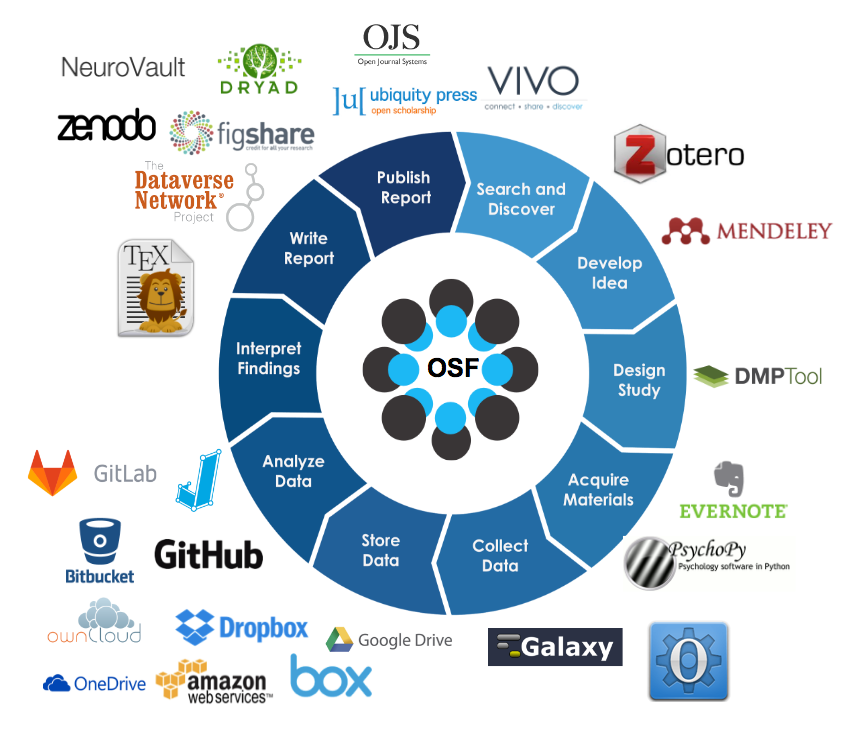
The Open Science Framework is a free and open source project management system that supports researchers.
Some of its capabilities are:
- Searching articles, conference papers and similar works in the shared repository,
- Uploading your research,
- Organizing your research more easily by creating new folders within the system,
- Working interactively on the same research project with the people of your choice,
- Making any desired part of the project publicly available,
- Connecting to many tools researchers already use (Mendeley, Zotero, Google Drive, Zenodo, etc.),
- Integrating the identifier IDs from these tools into the OSF system,
- The OSF Preservation Fund maintains and sustains read access to hosted data; this fund is sufficient to cover hosting costs for 50+ years.
To access the database, click here.
Scope: Social sciences, linguistics, psychology, law, geography, physical education, history, economics, literature, art studies, women's studies, management, philosophy and logic, library science, political science, humanities and Islamic sciences.
To access the database, click here.
Scope: Social sciences, linguistics, psychology, law, geography, physical education, history, economics, literature, art studies, women's studies, management, philosophy and logic, library science, political science, humanities and Islamic sciences.
To access the database, click here.
PQDT Open provides the full text of theses and dissertations free of charge. You can quickly and easily find dissertations in the discipline you are interested in and view the entire text in PDF format.
To access the database, click here.
Designed to complement other databases and collections, this database brings together, or provides links to the full text of, publicly available scholarly content from a range of different sources around the world. In addition to open access journals, it also covers content from major subject repositories such as arXiv. It includes journal articles, preprints, books, conference papers and reports.
Designed to complement other databases and collections, this database brings together or links to full text for publicly available scholarly content from a number of different sources from around the world. It includes content from major subject repositories such as arXiv as well as open access journals. Content includes journal articles, pre-prints, books, conference papers and reports.
To access the database, click here.
Founded in 2001 as an alternative to the increasing restrictions of traditional scholarly publishing, the Public Library of Science (PLOS) offers more than 250,000 articles across seven journals featuring expert commentary and critical analysis.
- PLOS ONE
- PLOS Biology
- PLOS Medicine
- PLOS Computational Biology
- PLOS Genetics
- PLOS Neglected Tropical Diseases
- PLOS Pathogens
To access the database, click here.
Designed to complement other databases and collections, this database brings together, or provides links to the full text of, publicly available scholarly content from a range of different sources around the world. In addition to open access journals, it also covers content from major subject repositories such as arXiv. It includes journal articles, preprints, books, conference papers and reports.
Designed to complement other databases and collections, this database brings together or links to full text for publicly available scholarly content from a number of different sources from around the world. It includes content from major subject repositories such as arXiv as well as open access journals. Content includes journal articles, pre-prints, books, conference papers and reports.
To access the database, click here.
- It is part of the FAPESP, CAPES, CNPq, BIREME and FAPUNIFESP projects.
- It aims to bring together South American and Latin American scientific journals on a single portal.
- It is continuously growing with new journals and new content.
- In addition to scientific journals, it also hosts databases such as books and the biodiversity heritage library.
To access the database, click here.
Designed to complement other databases and collections, this database brings together, or provides links to the full text of, publicly available scholarly content from a range of different sources around the world. In addition to open access journals, it also covers content from major subject repositories such as arXiv. It includes journal articles, preprints, books, conference papers and reports.
Designed to complement other databases and collections, this database brings together or links to full text for publicly available scholarly content from a number of different sources from around the world. It includes content from major subject repositories such as arXiv as well as open access journals. Content includes journal articles, pre-prints, books, conference papers and reports.
To access the database, click here.
Designed to complement other databases and collections, this database brings together, or provides links to the full text of, publicly available scholarly content from a range of different sources around the world. In addition to open access journals, it also covers content from major subject repositories such as arXiv. It includes journal articles, preprints, books, conference papers and reports.
Designed to complement other databases and collections, this database brings together or links to full text for publicly available scholarly content from a number of different sources from around the world. It includes content from major subject repositories such as arXiv as well as open access journals. Content includes journal articles, pre-prints, books, conference papers and reports.
To access the database, click here.
Designed to complement other databases and collections, this database brings together, or provides links to the full text of, publicly available scholarly content from a range of different sources around the world. In addition to open access journals, it also covers content from major subject repositories such as arXiv. It includes journal articles, preprints, books, conference papers and reports.
Designed to complement other databases and collections, this database brings together or links to full text for publicly available scholarly content from a number of different sources from around the world. It includes content from major subject repositories such as arXiv as well as open access journals. Content includes journal articles, pre-prints, books, conference papers and reports.
To access the database, click here.
Designed to complement other databases and collections, this database brings together, or provides links to the full text of, publicly available scholarly content from a range of different sources around the world. In addition to open access journals, it also covers content from major subject repositories such as arXiv. It includes journal articles, preprints, books, conference papers and reports.
Designed to complement other databases and collections, this database brings together or links to full text for publicly available scholarly content from a number of different sources from around the world. It includes content from major subject repositories such as arXiv as well as open access journals. Content includes journal articles, pre-prints, books, conference papers and reports.
To access the database, click here.
Designed to complement other databases and collections, this database brings together, or provides links to the full text of, publicly available scholarly content from a range of different sources around the world. In addition to open access journals, it also covers content from major subject repositories such as arXiv. It includes journal articles, preprints, books, conference papers and reports.
Designed to complement other databases and collections, this database brings together or links to full text for publicly available scholarly content from a number of different sources from around the world. It includes content from major subject repositories such as arXiv as well as open access journals. Content includes journal articles, pre-prints, books, conference papers and reports.
To access the database, click here.
Designed to complement other databases and collections, this database brings together, or provides links to the full text of, publicly available scholarly content from a range of different sources around the world. In addition to open access journals, it also covers content from major subject repositories such as arXiv. It includes journal articles, preprints, books, conference papers and reports.
Designed to complement other databases and collections, this database brings together or links to full text for publicly available scholarly content from a number of different sources from around the world. It includes content from major subject repositories such as arXiv as well as open access journals. Content includes journal articles, pre-prints, books, conference papers and reports.
To access the database, click here.
It contains more than 5,112,000 electronic theses and scholarly studies/dissertations.
NDLTD is an international organization that promotes the writing, dissemination, use and preservation of electronic theses and dissertations. It supports electronic publishing and open access in order to increase the sharing of knowledge worldwide. It offers resources for university administrators, librarians, faculty members, students and general users.
To access the database, click here.
TR Dizin, created by ULAKBİM, covers 5 main subject areas: health sciences (medicine), engineering and natural sciences, social sciences and humanities, life sciences, and law.
The national scientific journals that make up the content of TR Dizin are selected according to journal evaluation criteria by committees consisting of ULAKBİM TR Dizin experts and specialists and academics in the relevant subject areas. It offers services such as the most cited journals, the most cited articles, the most cited authors and the journals with the highest impact value. It covers 1,755 journals. (April 2025)
To access the database, click here.
TR Dizin, created by ULAKBİM, covers 5 main subject areas: health sciences (medicine), engineering and natural sciences, social sciences and humanities, life sciences, and law.
The national scientific journals that make up the content of TR Dizin are selected according to journal evaluation criteria by committees consisting of ULAKBİM TR Dizin experts and specialists and academics in the relevant subject areas. It offers services such as the most cited journals, the most cited articles, the most cited authors and the journals with the highest impact value. It covers 1,755 journals. (April 2025)
To access the database, click here.
What is Aperta? Aperta, the Türkiye Open Archive, is a platform that holds research data currently produced by researchers in a standard data structure and that allows researchers to upload data.
The purpose of Aperta
Aperta, which enables the long-term storage, preservation, management, indexing and free access of the data of researchers working at universities and public institutions, was created with the aim of becoming a national data repository, and it seeks to promote the sharing of open access publications, data and software so that researchers can access the resources they need on an equitable basis. The Aperta Türkiye Open Archive is the version of the TÜBİTAK Open Archive (Aperta) that has been opened to researchers with an expanded scope.
The scope of Aperta
Aperta is designed as a data repository. With free DOI support, you can upload your research datasets easily and securely. In addition, all research outputs from all fields of science are accepted. A choice of file types can be made in the upload form: publications (books, book chapters, conference papers, journal articles, patents, preprints, reports, theses, technical notes, working papers, etc.), posters, presentations, datasets, images (figures, drawings, diagrams, photographs), software, video/audio recordings, and interactive materials such as lessons.
- Safe and reliable — As long as your data is held at TÜBİTAK ULAKBİM, it is stored securely by ULAKNET.
- DOI support — A Digital Object Identifier (DOI) is assigned so that records can be cited and tracked.
- No waiting time — Uploads become available online the moment the publish button is pressed, and the DOI is registered within minutes.
- Open or closed — Thanks to restricted access mode, anonymized clinical research data, for example, can be shared only with medical specialists.
- Versioning — You can easily update your dataset using the versioning feature.
- Usage statistics — All uploads can be viewed with standards-compliant usage statistics.
To access the database, click here.
Developed at TÜBİTAK ULAKBİM, the Türkiye Academic Archive (Harman) is a metadata harvesting software that establishes a link between national archives and journals (data providers) and search engine services (service providers), providing access to the required content in line with international standards. The aim is to harvest the metadata of national institutional open archive content and to provide access to publications through the Harman address.
Purpose
- To ensure that the metadata of the open archive content of research funding institutions is harvested in accordance with international standards,
- To provide access to open archive content at its own address.
Joining the Türkiye Academic Archive (Harman)
Harman harvests the metadata of institutional open archive content. Ensuring that this data complies with standards, that it is uploaded to and updated in institutional open archives, and that the archives operate without problems is the responsibility of the institutions. Data is retrieved from the access addresses of the data sources via APIs. Institutions wishing to join Harman must complete the participation form.
To access the database, click here.

It is a comprehensive health sciences portal. It searches databases and scientific journals in the field of health published worldwide, particularly in South America, Latin America and the Caribbean countries. It is available in English, Spanish and Portuguese.
Some of the databases it includes:
- MEDLINE
- LILACS
- WHO IRIS
- IBECS
- BINACIS
- PAHO
- BDENF - Nursing
- CUMED
- BBO - Dentistry
- Coleciona SUS
- LIS - Health Information Locator
- Desastres - Disasters
- MedCarib
- PAHO-IRIS
- Sec. Munic. Saúde SP
- HomeoIndex Homeopathy
- Sec. Est. Saúde SP
- Hanseníase Leprosy
- Index Psychology - Scientific journals
- VHLMINSA
- CidSaúde - Healthy cities
- RHS Repository
- BRISA/RedTESA
To access the database, click here.
WorldWideScience.org is a global science gateway composed of national and international scientific databases and portals. It accelerates scientific discovery and progress by searching databases from around the world from a single point. Thanks to its multilingual structure, it enables real-time searching and translation of globally dispersed multilingual scientific literature.
The WorldWideScience Alliance, a multilateral partnership, consists of participating member countries and provides the governance structure for WorldWideScience.org.
To access the database, click here.

Designed to complement other databases and collections, this database brings together, or provides links to the full text of, publicly available scholarly content from a range of different sources around the world. In addition to open access journals, it also covers content from major subject repositories such as arXiv. It includes journal articles, preprints, books, conference papers and reports.
Designed to complement other databases and collections, this database brings together or links to full text for publicly available scholarly content from a number of different sources from around the world. It includes content from major subject repositories such as arXiv as well as open access journals. Content includes journal articles, pre-prints, books, conference papers and reports.
To access the database, click here.
It was created and developed by researchers so that everyone can take part in open science.
The OpenAIRE project, funded by the European Commission and a pioneer of the open access and open data movements in Europe, aims to build a broad open access repository for research and to support open science policies.
Zenodo is hosted by CERN, which has been operating since 1954 and has a defined experimental program for the next 20+ years. A memory institution in the field of high energy physics, CERN is known for its pioneering work in open access. Organizationally, Zenodo is part of the IT Department, Collaboration Devices and Applications Group, Digital Repositories Section (IT-CDA-DR). Zenodo is provided by CERN as part of its mission to make the results of its work available.
Zenodo is funded by the following institutions:
- OpenAIRE projeleri aracılığıyla Avrupa Komisyonu:
- FP7: OpenAIRE (246686), OpenAIREplus (283595)
- Horizon 2020: OpenAIRE2020 (643410), OpenAIRE-Connect (731011) and OpenAIRE-Advance (777541)
- CERN
- Alfred P. Sloan Foundation
- Arcadia Fund
- Donations made through the CERN & Society Foundation
CERN is an active member of the following organizations (the list is not exhaustive):
- DataCite
- ORCID
- FORCE11 (in particular the Data Citation Principles and the Software Citation Principles)
- Research Data Alliance
- SCOAP3
To access the database, click here.