

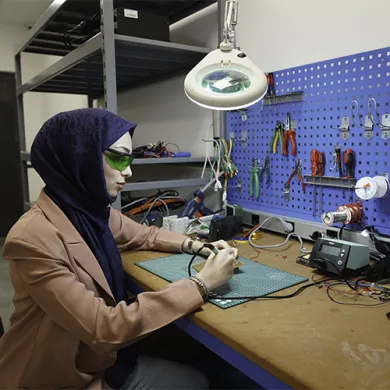
In the Department of Electrical-Electronics Engineering (30% English), our aim is to train students who know how to access information when needed, who learn through research, and who possess an analytical mindset capable of continuously renewing themselves throughout their lives. Throughout their studies, students are equipped with humanities knowledge, communication skills and cultural flexibility, guided by principles such as allowing them to form and develop their own interests, creating an academic programme with a strong humanities component, offering an education based on understanding and research rather than memorisation, and building a close, warm student/faculty relationship.
In the first year of our undergraduate programme, students are given general engineering courses (physics, mathematics, computing, etc.). In the second year, professional courses begin alongside general engineering formation courses. Having completed the fundamentals of electrical engineering in the third year, students choose one of four core areas (Electronics, Communications & Signal Processing, Control & Robotics, Power Systems, Renewable Energy) in the fourth year and continue in that area. Alongside compulsory courses, our department offers a rich elective course programme that students can take according to their interests.
Opportunities Offered to Students:
Opportunity to learn a foreign language (free of charge),
Opportunity to pursue a minor (scholarship-funded for the normal duration of the major programme),
Opportunity to pursue a double major (scholarship-funded for the normal duration of the Double Major programme),
Opportunity to study abroad through international exchange programmes (1 or 2 semesters),
Opportunity to continue to postgraduate programmes after graduation.
Career Opportunities:
Graduates can find employment in our country's energy sector, the electromechanical industry and the electronics industry, and can take up positions in the electrical and electronics units of public institutions. They can work in organisations' electricity generation plants, rural electrification, energy systems, industrial automation, telecommunications, lighting, power installations, and computer software and hardware fields.
A student who successfully completes the programme may apply for master's and doctoral degrees in the field of Electrical-Electronics Engineering or in other scientific fields that accept students from this background.
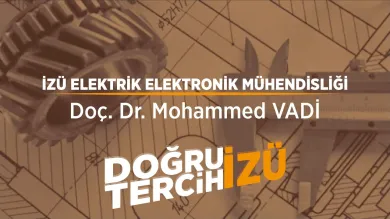
Assoc. Prof. Dr. Mohammed VADİ
Head of the Electrical-Electronics Engineering 30% English Programme
Student Reviews

Ece Yılmaz Computer Engineering
At IZU, I didn't just learn programming; I also learned how to analyse a problem and develop solutions. Thanks to the project-based approach to education, I had the opportunity to prepare for real working life before I even graduated.

Mehmet Akif Demir Software Engineering
The support of my instructors and hands-on courses played an important role in developing myselfin software development. After graduating, I stepped into the technology sector with confidence.
Zeynep Kılıç Interior Architecture
The projects I carried out with friends from different disciplines taught me the value of teamwork. The technical knowledge and perspective I gained at IZU gave me a strong startto my career.
Burak Can Özkan Food Engineering
Thanks to the laboratory facilities and course content focused on current technologies, I had the opportunity to turn theoreticalknowledge into practice. The experience I gained at IZU guides me in the projects I work on.
Elif Su Aydın Industrial Engineering
IZU gave me not only engineering knowledge but also a habit of continuous learning.Thanks to the projects I developed during my university years, I was able to start working as soon as I graduated.