
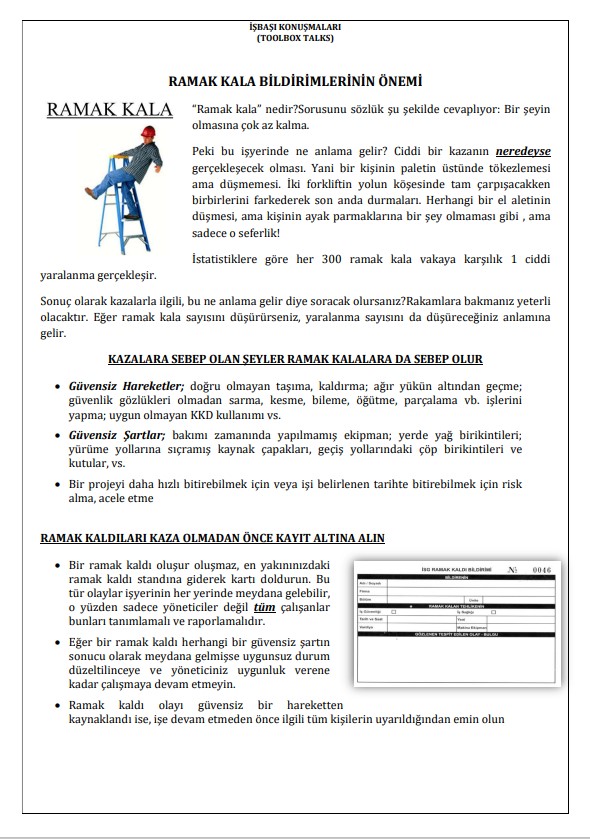
Near Miss Incident
These are incidents occurring in the workplace that have the potential to harm an employee, the workplace or work equipment but do not actually cause harm. If we apply this to everyday life, we might call them a close call or a near miss. Slipping on a wet floor and falling, or tripping over cables in the work area and falling, are occupational accidents; however, stepping on a wet floor and saying "I almost fell" or "I only just avoided falling" is a Near Miss Incident. Judging by these simple examples, near miss incidents are early warnings of occupational accidents. If we do not report or prevent such an incident, we may face an occupational accident the next time.
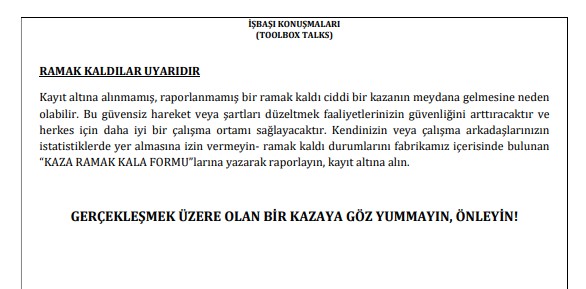
Pursuant to Occupational Health and Safety Law No. 6331, all near miss incidents must be recorded. Recording and reporting such incidents is of vital importance in preventing occupational accidents. This is because reporting Near Miss Incidents is of great importance for identifying and preventing occupational accidents that may occur in the future.
According to statistics, for every 300 near miss incidents there are 29 accidents involving injury, and for every 29 accidents involving injury there is 1 fatal or seriously injurious accident. In this respect, keeping near miss records is of vital importance for preventing occupational accidents in the workplace.
Occupational health and safety consists of systematic and scientific efforts aimed at minimising the health and safety risks that employees may face in the workplace. These efforts aim to prevent occupational accidents and occupational diseases.
Basic Principles
Risk Assessment: Identifying the hazards in the workplace and assessing the risks arising from them.
Preventive Measures: Planning and implementing the measures to be taken against the identified risks.
Training and Information: Training and informing employees on occupational health and safety matters.
Inspection and Monitoring: Regularly checking and monitoring the effectiveness of the measures taken in the workplace.
Occupational Health and Safety Law
In Türkiye, occupational health and safety is regulated by Occupational Health and Safety Law No. 6331. This law sets out the duties, powers, responsibilities, rights and obligations of employers and employees
Key Topics
Personal Protective Equipment (PPE): Protective equipment that employees must use in the workplace.
Emergency Plans: What must be done in emergencies such as fire and earthquake.
Occupational Accidents and Occupational Diseases: Measures to be taken to prevent occupational accidents and occupational diseases.
Occupational Hygiene: Ensuring hygienic conditions in the workplace.
OHS Culture
OHS culture means that all employees and employers act with a shared awareness and sense of responsibility in order to create a safe and healthy working environment in the workplace. Establishing and maintaining this culture is of great importance in preventing occupational accidents and occupational diseases.
Do you feel obliged to look at the steps when using the stairs in the workplace?
Would you say that lighting is inadequate in some areas of the workplace?
Have you received an electric shock anywhere on the premises?
Are there any cables in your work area, or in areas of the workplace where you may be present, that are worn, stripped, bent, tangled, etc.? (including the cables of the machinery/tools/equipment you use)
Have you noticed any damaged plugs or sockets in the workplace?
Is there any possibility of you working near areas where there is an electrical hazard? (this refers not to areas where electricity is present, but to areas where you consider the risk of electric shock to be high)
Are there any rough, worn or broken floor surfaces that make walking difficult?
Are there any cables in areas designated for walking?
Are there any floor areas that become slippery due to an external factor or that are permanently slippery?
Are there any materials left lying around on the floors?
Are there areas in your workplace where highly flammable materials are used?
Do you know where the fire extinguishers are located in the workplace?
CLICK HERE TO DOWNLOAD THE FORM
NEAR MISS TRAINING PARTICIPATION FORM |
| Title of the Place Where the Training Is Given | ISTANBUL SABAHATTIN ZAIM UNIVERSITY | ||||||
| Purpose and Subject of the Training | NEAR MISS TRAINING | ||||||
| Duration of the Training | …… HOURS | ||||||
TRAINING TOPICS 1. What Is a Near Miss? 2. What Should Be Done When a Near Miss Occurs? 3. How Should the Near Miss Form Be Completed? 4. Factors by Which Keeping Near Miss Reporting Records Prevents Occupational Accidents. 5. What Is an Occupational Accident?
| |||||||
TRAINING PARTICIPANTS | |||||||
No | Full Name | Position |
ID NO:
| Date …../……/20…. Signature | |||
1 | |||||||
2 | |||||||
3 | |||||||
4 | |||||||
5 | |||||||
6 | |||||||
7 | |||||||
8 | |||||||
9 | |||||||
10 | |||||||
11 | |||||||
12 | |||||||
13 | |||||||
14 | |||||||
OCCUPATIONAL SAFETY SPECIALIST |
EMPLOYER/EMPLOYER'S REPRESENTATIVE
To Submit a Near Miss Report, Please Download and Complete the Form Below and Send It to personel@izu.edu.tr .
CLICK HERE TO DOWNLOAD THE FORM.
E-mail: personel@izu.edu.tr
ACCIDENT NEAR MISS FORM
Full Name of the Person Who Escaped the Hazard Department and Position Date of Employment Place Where the Hazard Was Escaped Date/Time the Hazard Was Escaped Time Work Started Work Being Carried Out at the Time the Hazard Arose |
Describe the Hazard That Was Narrowly Avoided:
|
Explain the Exact Location of the Hazard:
|
Measures to Be Taken: |
Opinion of the Supervisor Receiving the Report:
|
Opinions of the Occupational Safety Specialist and the Accident and Incident Investigation Team:
|
SIGNATURE