

Industrial Engineering is the branch of engineering that uses scientific methods so that all kinds of systems, including those involving people, can use their limited resources more effectively and efficiently; in light of these methods, it analyses people, machines, materials, information and energy, and designs, organizes and manages systems and processes. Industrial engineers take the human factor into account in everything they do. They find, apply, have applied and manage methods for higher-quality, cheaper, easier and faster production. As the department at Istanbul Sabahattin Zaim University, we are working to create a programme that supports student-centred learning with scientific techniques and methods such as Operations Research, Statistics, Ergonomics, Simulation, Supply Chain Management, Time Study, 6 Sigma and Work Sampling, with continuously updated course content, and that gives students the knowledge and skills needed to design, develop and implement systems.
The word 'industrial' in Industrial Engineering should not be understood only in the sense of manufacturing industry. The name comes from the fact that it was initially a branch of engineering that developed in manufacturing systems, but today it has become a branch of engineering that works for the efficient and high-quality output of all kinds of systems producing products, services and information.
Industrial engineers have the opportunity to work in all sectors. They take part in every stage, from product development to delivery to the customer. The aim of industrial engineering is to ensure profitability, effectiveness, efficiency, flexibility, responsiveness and high quality. The continuous improvement of processes related to products and services is part of this programme. To achieve these results, the Industrial Engineer acquires competencies in the basic sciences, management sciences, computer sciences, humanities and social sciences, and modern communication skills.
Opportunities Offered to Students:
Opportunity to learn an additional foreign language (free of charge),
Opportunity to do a minor (with a scholarship for the normal duration of the major programme),
Opportunity to do a double major (with a scholarship for the normal duration of the double major programme),
Opportunity to study abroad through international exchange programmes (1 or 2 semesters),
Opportunity to continue with master's programmes after graduation.
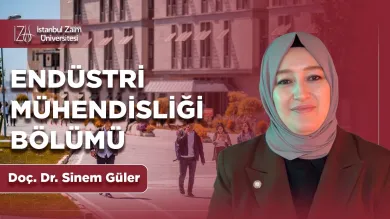
Assoc. Prof. Dr. Sinem GÜLER
Head of the Industrial Engineering (30% English) Programme

Student Reviews

Ece Yılmaz Computer Engineering
At İZÜ I did not only learn programming; I also learned how to analyse a problem and produce solutions. Thanks to the project-oriented approach to education, I had the opportunity to prepare for real working life before graduating.

Mehmet Akif Demir Software Engineering
The support of my lecturers and the practical courses played an important part in helping medevelop myself in the field of software development. After graduating, I stepped into the technology sector with confidence.
Zeynep Kılıç Interior Architecture
The projects we carried out with friends from different disciplines taught me the value of teamwork. The technical knowledge and perspective I gained at İZÜ gave my career a strongstart.
Burak Can Özkan Food Engineering
Thanks to the laboratory facilities and course content focused on current technologies, I had the opportunity to turn theoreticalknowledge into practice. The experience I gained at İZÜ guides me in the projects I work on.
Elif Su Aydın Industrial Engineering
İZÜ gave me not only engineering knowledge but also the habit of continuous learning.Thanks to the projects I developed during my university years, I was able to start working as soon as I graduated.